Vivek Jha, Bhopal: In a significant move aimed at reducing litigation and encouraging voluntary compliance, the Employees’ Provident Fund Organisation (EPFO) has launched “VISHWAS 2026”, a special dispute resolution scheme designed to facilitate the amicable settlement of damages levied under Section 14B of the Employees’ Provident Funds and Miscellaneous Provisions Act, 1952, and the corresponding provisions under the Code on Social Security, 2020.
The scheme, notified by the Government of India on 29 June 2026, provides a one-time opportunity for eligible establishments to settle long-pending EPF damage cases at substantially reduced rates. The initiative is expected to benefit thousands of employers across the country while significantly reducing pending litigation before various judicial forums.
A Major Reform to Resolve Long-Pending EPF Disputes
For many years, disputes relating to damages imposed for delayed remittance of provident fund contributions have remained pending before tribunals, courts and other judicial authorities. These cases have resulted in prolonged litigation, increased compliance costs and administrative burden for both employers and EPFO.
Through VISHWAS 2026, EPFO aims to provide employers with a transparent, time-bound and business-friendly mechanism for resolving such disputes while ensuring that employees’ statutory social security interests remain protected.
The scheme will remain operational for six months from the date of notification.
Who Can Avail the Scheme?
The scheme covers four major categories of cases involving damages under Section 14B:
1. Ongoing Litigation Cases
Cases where damage orders have already been issued and are currently pending before any judicial or quasi-judicial authority.
2. Finalized Damage Orders
Cases where damage orders have been passed but the amount has not been fully recovered or has been only partially paid.
3. Pre-Adjudication Cases (Notice Issued)
Cases in which a notice has been issued but the final order is yet to be passed.
4. Pre-Adjudication Cases (Notice Yet to be Issued)
Cases where proceedings are yet to begin and notices have not been issued.
By covering almost every stage of litigation and adjudication, the scheme is expected to resolve a large number of pending disputes across industries.
Reduced Damages Under VISHWAS 2026
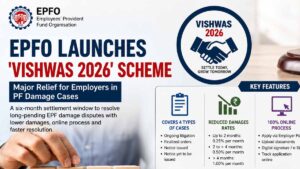
One of the biggest attractions of the scheme is the significant reduction in the rate of damages for defaults occurring before 14 June 2024.
The revised rates are:
- Default up to 2 months: 0.25% per month
- Default from 2 months to less than 4 months: 0.50% per month
- Default exceeding 4 months: 1.00% per month
These rates are considerably lower than the damages normally leviable under the EPF provisions, offering substantial financial relief to eligible establishments.
Interest Payment is Mandatory
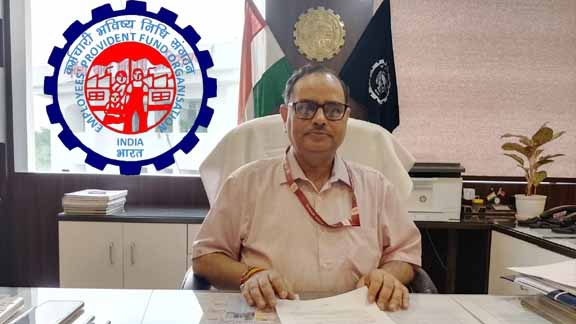
Shri Gautam, Additional Central Provident Fund Commissioner (Madhya Pradesh & Chhattisgarh), EPFO, stated that payment of the entire statutory interest for the default period is a mandatory precondition for availing the benefits of the VISHWAS 2026 scheme. He emphasized that establishments failing to deposit the applicable interest would not qualify for the scheme. He also informed that employers must furnish a formal undertaking declaring that, upon settlement under VISHWAS 2026, they shall not pursue any further appeal or legal proceedings in respect of the same dispute, ensuring finality and speedy resolution of pending cases.
Completely Digital Application Process
To ensure transparency and ease of compliance, the entire application process has been made online.
Employers will be required to:
- Submit applications through the EPFO Employer Portal.
- Authenticate applications using Digital Signature Certificate (DSC) or e-Sign.
- Update PAN, email ID and mobile number if not already available.
- Upload relevant documents and proof of payment.
- Provide details including:
- Period of default
- Reference order number
- Order date
- Damages imposed
- Amount already paid
- Proof of interest payment
- Furnish mandatory declarations and consent.
Once submitted, applications will be processed electronically by the Regional Office before final approval. Upon payment of the revised amount, digitally signed settlement certificates will be issued online.
How Partial Payments Will Be Treated
The scheme clearly defines the treatment of establishments that have already deposited part of the damages.
- If the amount already paid is higher than the revised damages under VISHWAS 2026, no refund will be granted.
- If the amount already paid is lower, the employer will only be required to pay the differential amount.
Similarly, pre-deposits made while filing appeals will also be adjusted according to the revised calculations under the scheme.
Cases Excluded from the Scheme
Certain categories have been specifically kept outside the scope of VISHWAS 2026:
- Establishments where damages have already been fully recovered.
- Cases involving fraud, embezzlement or deliberate falsification of records.
- Cases where statutory interest has not been fully deposited.
Such establishments will continue to be governed by the normal legal provisions.
Dedicated Help Desks Across India
To ensure smooth implementation, EPFO has instructed all Regional, Zonal and District Offices to establish:
- Dedicated VISHWAS Cells
- Employer Help Desks
- Nodal Officers
- Public awareness campaigns
- Industry outreach programmes
Employers eligible under the scheme will also be contacted individually through letters, emails and SMS wherever applicable.
Benefits for Employers
Industry experts believe the scheme offers several advantages:
- Significant reduction in damages.
- Faster settlement of pending litigation.
- Lower legal expenses.
- Better compliance environment.
- Improved ease of doing business.
- Opportunity to regularize old EPF disputes.
- Reduced uncertainty for businesses.
For many MSMEs and industrial establishments, the scheme could substantially reduce their financial burden arising out of legacy EPF disputes.
Benefits for EPFO
The scheme is equally beneficial for EPFO as it is expected to:
- Reduce long-pending litigation.
- Improve recovery of dues.
- Increase voluntary compliance.
- Reduce administrative burden.
- Strengthen employer confidence in the compliance framework.
- Promote quicker disposal of pending cases.
Experts Advise Employers Not to Miss the Opportunity
Labour law professionals and compliance experts have advised employers to immediately review all pending Section 14B cases and determine their eligibility under VISHWAS 2026.
Since the scheme is available only for a limited period of six months, timely application can help businesses secure substantial financial relief and close long-pending disputes through a simplified process.
VISHWAS 2026 – At a Glance
| Particular | Details |
|---|---|
| Scheme Name | VISHWAS 2026 |
| Launched By | Employees’ Provident Fund Organisation (EPFO) |
| Effective From | 29 June 2026 |
| Validity | Six Months |
| Objective | Amicable settlement of EPF damage disputes |
| Applicable Cases | Litigation, finalized orders, notice issued, notice yet to be issued |
| Mandatory Condition | Full payment of statutory interest before application |
| Application Mode | Online through Employer Portal |
| Settlement Certificate | Issued digitally after approval and payment |
Who Should Consider Applying?
The scheme is particularly relevant for:
- Manufacturing industries
- MSMEs
- Commercial establishments
- Educational institutions
- Hospitals
- Service sector companies
- Infrastructure firms
- Chartered Accountants
- Labour law consultants
- HR and compliance professionals
- Corporate legal teams
A Significant Step Towards Compliance-Friendly Governance
The launch of VISHWAS 2026 marks one of the most significant compliance reforms undertaken by EPFO in recent years. By combining reduced damages, digital processing, structured timelines and employer-friendly procedures, the scheme seeks to resolve legacy disputes while strengthening India’s social security ecosystem.
For employers carrying unresolved EPF damage cases, VISHWAS 2026 presents a valuable opportunity to settle disputes, reduce liabilities and move forward with greater regulatory certainty.
VISHWAS 2026 – Frequently Asked Questions (FAQs)
A Complete Guide for Employers, Industries, HR Professionals, Chartered Accountants and Labour Law Consultants
The Employees’ Provident Fund Organisation (EPFO) has launched VISHWAS 2026, a one-time dispute resolution scheme to facilitate the amicable settlement of cases relating to damages under Section 14B of the EPF & MP Act, 1952, or Section 128 of the Code on Social Security, 2020.
To help employers and stakeholders better understand the scheme, here are the most important questions and answers in a simple and comprehensive format.
GENERAL FAQs
Q1. What is VISHWAS 2026?
Answer:
VISHWAS 2026 is a one-time settlement scheme introduced by EPFO to enable eligible establishments to settle cases relating to damages imposed under Section 14B of the EPF Act or Section 128 of the Code on Social Security.
The scheme provides a transparent, time-bound mechanism for settlement by allowing employers to pay damages at substantially reduced graded rates.
Q2. How long will the scheme remain open?
Answer:
The scheme will remain operational for six months from the date of notification.
If required, the Government may extend the scheme for an additional period, not exceeding another six months.
Q3. Which cases are covered under VISHWAS 2026?
The scheme covers four categories of cases:
1. Cases Under Litigation
Where an order under Section 14B or Section 128 has already been issued and the matter is pending before any court, tribunal or judicial authority.
2. Orders Issued but Recovery Pending
Cases where damages have been assessed but the amount has not yet been fully recovered.
3. Notice Issued but Final Order Pending
Cases where a notice has been issued but the final damages order has not yet been passed.
4. Notice Yet to be Issued
Cases where proceedings are proposed but the notice has not yet been issued.
Q4. Which cases are excluded from the scheme?
The following cases are not eligible:
- Establishments where damages have already been fully recovered.
- Cases involving fraud, misappropriation or deliberate falsification of records.
- Cases where the entire interest amount has not been paid.
FAQs FOR EMPLOYERS
Q5. What are the revised rates of damages under VISHWAS 2026?
| Period of Default | Revised Damages Rate |
|---|---|
| Less than 2 months | 0.25% per month |
| 2 months to less than 4 months | 0.50% per month |
| 4 months and above | 1.00% per month |
These reduced rates will be applied while recalculating damages.
Q6. How can an employer apply?
Applications can be submitted online through the EPFO Employer Portal.
Employers need to:
- Log in to the Employer Portal.
- Select “VISHWAS 2026”.
- Complete the online application.
- Upload the required documents.
- Submit the prescribed declaration.
Q7. What documents are required?
Depending on the category of the case, employers may be required to upload:
- Damage Order or Notice
- Court case details (if litigation is pending)
- Challan/payment details
- Prescribed undertaking/declaration
Q8. How will the recalculated damages be communicated?
After verification, EPFO will communicate the revised amount through the Employer Portal.
The employer can log in and download the revised calculation.
Q9. What is the payment timeline?
The employer must:
- Accept the recalculated amount, and
- Pay it within 15 days from the date of communication.
If payment cannot be made within 15 days, the employer may request an additional 15-day extension.
Q10. What happens if payment is not made on time?
If payment is not made within the prescribed period:
- The application will be treated as forfeited.
- The employer will lose the benefit of VISHWAS 2026.
- Original legal proceedings will continue.
Q11. What is a VISHWAS 2026 Certificate?
After full payment, EPFO will issue a Digitally Signed VISHWAS 2026 Certificate.
The certificate serves as:
- Final proof of settlement.
- Documentary evidence for withdrawal of pending cases before Courts or CGIT.
Q12. Will Principal Contribution or Interest be waived?
No.
The scheme does not waive:
- EPF Contribution (Principal)
- Interest
The concession is only on Damages.
FAQs FOR EPFO FIELD OFFICES
Q13. Which offices will process applications?
Applications will be processed by the designated PD Cell/Compliance Section of the concerned Regional or District Office through the centralized VISHWAS Module.
Q14. How will damages be recalculated?
Damages will be recalculated using EPFO’s System-Based Calculation Tool.
Where required, CSV-based worksheets may be used, but the final calculation will always be generated through the system.
Q15. Can manual recalculation be done?
Normally, No.
Manual intervention is permitted only in exceptional cases where the finally assessed damages differ from the original notice.
Even then, proper justification and audit trail are mandatory, and the final amount will still be generated by the system.
Q16. How are pre-deposits treated under VISHWAS 2026?
If an employer has already deposited the statutory pre-deposit with EPFO while filing an appeal:
If the deposited amount is lower
The employer only needs to pay the differential amount.
If the deposited amount is higher
The excess amount may be adjusted against future damage orders relating to subsequent periods.
Q17. Are deposits made with authorities other than EPFO valid?
No.
Only deposits made with EPFO will be considered valid under the scheme.
Q18. What happens after the VISHWAS Certificate is issued?
After issuance of the certificate:
- Pending appeals shall stand abated.
- The certificate may be produced before Courts/CGIT for withdrawal of litigation.
Q19. What if the employer does not accept the revised amount?
If the employer:
- refuses to accept the recalculated amount, or
- fails to pay within the prescribed period,
the application will fail and the original legal proceedings will continue.
Q20. How will implementation be monitored?
EPFO will monitor the scheme through dedicated MIS Dashboards showing:
- Applications received
- Applications approved
- Applications rejected
- Amount recalculated
- Amount recovered
- Regional performance
- Zonal performance
Q21. Is VISHWAS 2026 an open-ended scheme?
No.
The scheme is available only for a limited period.
Field offices have been instructed to dispose of all applications within the scheme period.
Q22. Are employees’ interests protected?
Yes. Absolutely.
The scheme does not dilute employees’ statutory rights.
Employees’ interests remain fully protected because:
- PF contributions remain payable.
- Interest remains payable.
- Social Security benefits remain unaffected.
- Only the damages component is recalculated under the scheme.
VISHWAS 2026 – At a Glance
| Particular | Details |
| Scheme | VISHWAS 2026 |
| Implementing Authority | Employees’ Provident Fund Organisation (EPFO) |
| Objective | Settlement of EPF damage disputes |
| Applicable To | Eligible employers and establishments |
| Validity | Six months from notification |
| Application Mode | Online through Employer Portal |
| Relief Available | Reduced damages only |
| Principal Contribution | No waiver |
| Interest | No waiver |
| Settlement Certificate | Digitally Signed VISHWAS 2026 Certificate |
Expert Advice
Employers having pending Section 14B proceedings, notices, appeals or damage orders should immediately assess their eligibility under VISHWAS 2026 in consultation with their Chartered Accountant, Labour Law Consultant or Legal Advisor.
Since the scheme is available only for a limited period, timely action can significantly reduce financial liability, resolve legacy disputes and ensure smoother statutory compliance with EPFO.